
TLDR Highlights:

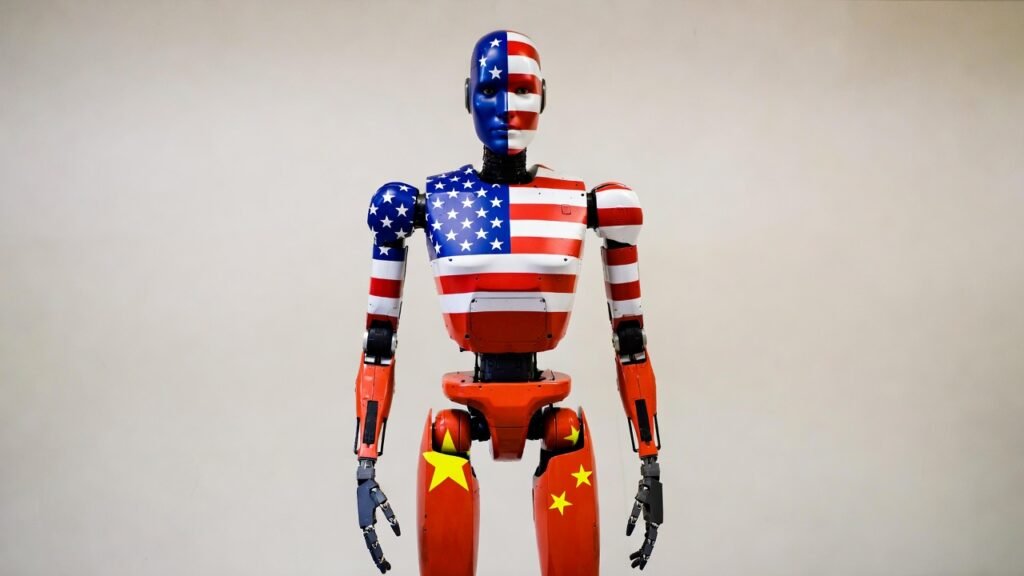
The Brain vs. Body Split: The West is betting on the "Brain" (AGI), while China is mass-producing the "Body" (Hardware). Is superior intelligence enough if you can't build the vessel at scale?

The $131,000 Reality Check: We’ve crunched the numbers on building a humanoid robot without a Chinese supply chain. The price jump is more than a hurdle; it’s a brick wall for Western reshoring.

The "Skeleton" Problem: Silicon Valley owns the software "peaks," but the mid-stream "skeleton" of assembly and precision gearing has moved East. Can the West rebuild four decades of outsourced industry in a four-year political cycle?

The Dependency Paradox: The very robots meant to facilitate "decoupling" currently rely on the "Optimus Chain" a web of suppliers that leads straight back to Shenzhen.
In today’s globalised industry, robots are poised to outshine cars as the next big product, a peculiar schism has emerged. On one side, the West clings to its technical superiority, on the other, China flexes its manufacturing muscles. The resulting contest promises to reshape economies, if only everyone could agree on the rules. Or perhaps not agree at all, which seems the more likely outcome.
The Strategic Divergence (The “Brain” vs. The “Body”)
One might say the West has always fancied itself the thinker in the room. In humanoid robotics, this manifests as a laser-like focus on the software that makes these metal plebs tick. Companies such as Figure AI and Tesla are pouring resources into Large Behaviour Models (LBMs), those sprawling neural networks that enable robots to reason, adapt, and perhaps one day ponder their own existence. It is a strategy rooted in the belief that the true value lies not in the chassis but in the cognition (which to some extent I agree with).
Tesla, for instance, envisions its Optimus as an extension of artificial general intelligence, a body merely hosting the mind. Boston Dynamics, with its acrobatic Atlas, emphasises end-to-end learning that allows robots to navigate chaos with a grace that borders on the uncanny. The West’s edge here is undeniable, dominance in foundational models, where American firms control the architectures that underpin robotic decision-making. It is a high-stakes gamble, assuming that superior smarts will command premium prices in enterprise settings, from warehouses to hospitals. After all, who needs cheap hardware when your robot can philosophise about the task at hand?
The Chinese Thesis
China, ever the pragmatist, has taken a different tack, one that involves less pondering and more producing. By repurposing the colossal supply chains built for electric vehicles and smartphones, Beijing’s champions are commoditising the robotic “Body” with admirable efficiency. Firms like Unitree and Agibot draw on the same ecosystem that propelled BYD to automotive stardom, high-energy-density batteries, thermal management systems, and perception sensors honed in the cutthroat EV market. This is no accident; it is the fruit of two decades of state-directed investment, where components like high-torque motors and LiDAR units, once exotic, are now churned out at volumes that make Western eyes water.
The Beijing Humanoid Robot Innovation Center exemplifies this, with its “Tiangong” platform offering an open-source blueprint for hardware, allowing startups to skip reinventing the wheel and focus on niches like dexterous hands or tactile skins. Think of it as the Android operating system but for robots and you get the idea.
It is a horizontal ecosystem, where agglomeration trumps isolation, fostering a explosion of innovation. While the West dreams of robots that think like humans, China builds ones that work like machines, and at prices that make you think twice about dismissal.
The Outcome
The result is a lopsided battle, think of it like chess master facing an army of pawns. Western robots, with their advanced reasoning, fetch eye-watering margins in pilot programmes for big corporations while board members get excited. Chinese offerings, however, flood the market as affordable commodities. Take the Unitree G1, priced at a mere $16,000, a figure that defies traditional cost calculations and positions it as a tool for research, education, and even broader commercial use. Look at it this way, you don’t need the most power to be the most utilised, the China approach looks to be the Rasberry Pi whilst the West is still aiming for Nvidia level margins.
This asymmetry means the West targets the ceiling of capability, while China owns the floor of accessibility. One suspects the real winner will be whoever scales first, although there may be a strong market for both solutions with the dumb robots covering the majority of labour roles.
The Reshoring Mirage (The Labour Offset)
Western leaders, (bless their optimistic out of touch souls), see humanoid robots as the silver bullet for reshoring. The idea is to close the “Agility Gap”, that yawning chasm where nimble supply chains have long favoured low-wage locations.
By deploying these automatons, high domestic labour costs become irrelevant; robots do not demand unions or overtime (yet lol). It is a vision of reclaimed industrial might, where factories in Ohio or Bavaria hum with mechanical efficiency, offsetting the wage premiums that have hollowed out manufacturing. Policymakers in the US, EU, and the Japan-South Korea-Taiwan bloc tout this as the path to resilience, a shift from globalisation’s efficiency to bifurcation’s security. One cannot help but admire the ambition, even if it feels a tad like building a castle on sand.
The “Skeleton” Problem: While the US dominates “frontier” assets like software and chip design, it lacks the mid-stream capacity (the industrial “skeleton”) to scale hardware production without external help.
Yet here lies the problem the West excels in “frontier” assets, those shiny peaks of software architecture, chip design, and financial capital. The JPK bloc holds sway over high-end process technologies. But the mid-stream “skeleton”, the grinding work of processing and assembly, remains China’s domain. Without this backbone, scaling humanoid production is a pipe dream. The US might design the cleverest algorithms, but fabricating the bodies at volume requires an ecosystem long outsourced. It is a logistical nightmare, unwinding four decades of integration doesn’t happen overnight and now is when we see the true price of previous trade “deals”.
The Productivity Bet
So the Western strategy relies on AI-driven automation becoming cost-competitive with rising Chinese wages by the late 2020s.
This bet hinges on productivity. As Chinese wages climb, AI-driven robots should tip the scales, becoming cheaper than human labour by the late 2020s. It is a calculated risk, banking on technological leaps to make reshoring viable. If successful, it could revive Western manufacturing; if not, well, made in China becomes as unescapable as a fart in an elevator.
The “Optimus Chain” Paradox (The Dependency Trap)
In reality, the West cannot easily build the very robots meant to facilitate decoupling without using the Chinese supply chain.
Ah, the irony, the robots designed to sever ties with China rely on Chinese parts. The “Optimus Chain”, that web of suppliers feeding Tesla’s ambitions, underscores this trap. Western firms preach decoupling, yet their hardware blueprints lead straight back to Shenzhen.
To build a Tesla Optimus Gen 2 unit using a purely “non-China” supply chain, costs would nearly triple. The numbers are stark. A Tesla Optimus Gen 2, leveraging Chinese components, clocks in at around $46,000 per unit. Strip away that chain, and costs balloon to $131,000. This delta stems not from labour but from the depth of the ecosystem: batteries, actuators, and sensors optimised over years in EVs. Morgan Stanley’s estimates highlight the bind; purity comes at a premium few can afford. I always viewed unchecked capitalism as stupid enough to sell the hangman the rope for its own execution and this is not changing my mind.
Chokepoint Dominance
China’s grip on chokepoints is clearly an obstacle. It processes nearly 90% of the world’s neodymium magnets, essential for high-torque motors that power robotic limbs. Precision gearing, once a Japanese duopoly, now sees Chinese firms like Leaderdrive offering 30-50% cost reductions with comparable quality. Hesai Technology commands a third of the global LiDAR market, commoditising sensors that Western robots cannot ignore without sacrificing performance.
Shifting final assembly might take three to five years, a sprint by industrial standards. But rebuilding the full mid-stream ecosystem? That is a decade-plus long march. The “Decoupling Paradox” bites hard, quick wins mask the long haul, leaving the West exposed in the interim.

The Final Twist (The “Neijuan” Factor)
Enter “neijuan”, or involution, that peculiar version of capitalism with Chinese characteristics where competition spirals inward, yielding diminishing returns. Firms chase the same shrinking pie, innovating furiously yet advancing nowhere. It is like hamsters on wheels, powered by state subsidies.
One of the things I “enjoyed” about living in China was the affordability of everything, it felt like everyone was constantly competing ferociously for custom. This has not changed and it actually appears to be accelerating for one reason more than any other. Local governments, ever eager for GDP glory, force capacity expansions that spark “suicidal” price wars. In EVs and robotics, margins vanish as overproduction floods markets. The solar PV saga illustrates: Chinese firms glutted the world, bankrupting Western rivals like Q-Cells and Solyndra, yet operated on thin margins sustained by state capital.
Advanced firms morph into “zombies”, shambling along on state credit without profits for R&D. Steel’s overcapacity, where 150 million tonnes were shuttered yet persisted via local bailouts, shows the trap. These entities preserve jobs but stifle true innovation.
Provocatively, loss-leader manufacturing, that tactic of undercutting rivals to monopoly, now looks like a risk of corroding the China model from within. Industries run at losses to dominate, but “growth without profits” breeds entropy. Add demographic collapse, with shrinking labour pools, and the model teeters. China’s trinity of distorted policies, once a strength, now fuels internal decay like never before.
In this fragile equilibrium, the West may win the “battle for the ceiling” in AI and IP, while China holds the “battle for the floor” in materials and volume. Yet both are brittle, the West ensnared by physical dependency, China by its own entropic limits. Maybe the outcome will be one where this fragile balance is the best-case outcome, as one winner and one loser rarely ends well for the global economy anyway.
Like what you read? Why not sign up to our newsletter below and help us grow 🙂
Lab notes:

Cost Analysis: Excluding Chinese parts could triple Tesla Optimus costs (Tech Digest)

Pricing Benchmarks: Unitree G1: Pricing, Specs & 2026 Guide (BotInfo)

Hardware Platform: China Open-Sources Tiangong Advanced AI Robot (YouTube/X-Humanoid)

Market Trends: Chinese robotics outlook for 2026 (The Robot Report)

Strategic Context: China narrows AI gap as Western tech leaders sound alarm at Davos 2026 (Ynet News)